
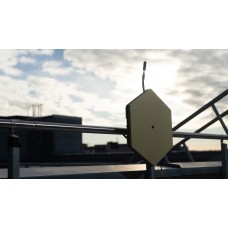
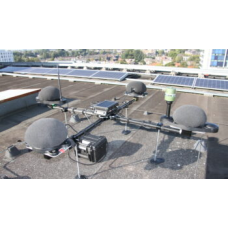
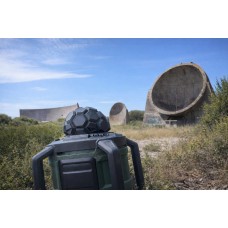

Acoustic drone detection is a strictly passive sensing layer that identifies aircraft by the distinctive harmonic signature of their rotors and motors. With zero RF emissions, acoustic arrays detect autonomous and radio-silent drones that passive RF sensors cannot hear.
How the technology works and what it detects
Multi-microphone beamforming arrays (such as the 128-mic Discovair G2 Plus) and acoustic vector sensors (such as Microflown AVISA SKYSENTRY) calculate 3D sound arrival angles and match harmonic patterns against drone acoustic libraries. Acoustic sensors work even at low altitudes behind minor visual obstructions, though their effective range is shorter than RF and depends on ambient noise and wind conditions.
Key selection criteria for civil sites
- Ambient noise profile: quiet perimeters, substations, and estates yield substantially longer acoustic detection ranges than active runways or highways.
- Sensor architecture: compare large beamforming arrays (high directional noise rejection) against compact acoustic vector sensors.
- Multi-node spacing: deploy nodes along low-altitude approach corridors to cover shadowed areas between buildings.
- Open APIs (TAK, SAPIENT) to fuse acoustic bearings with RF sensors and automatically cue EO/IR cameras.
Comparison of representative models in this category
| Model | Manufacturer | Deployment | Primary strength |
|---|---|---|---|
| Discovair G2 Plus | Squarehead Technology | Fixed array | 128 microphones, TAK / SAPIENT |
| SKYSENTRY | Microflown AVISA | Compact node | Acoustic vector 3D bearing |
| HARK | Arcani Systems | Perimeter / mobile | Passive acoustic sensor (DIANA) |
Site planning, integration & procurement checklist (RFQ)
- Site geometry and line-of-sight review: before finalizing models, prepare a perimeter layout with roof or mast elevations, priority approach sectors, and local sources of RF or acoustic interference.
- Power, network, and cybersecurity readiness: confirm PoE or AC/DC power availability, backhaul links, and whether your IT policy requires air-gapped on-premises servers or permits cloud dashboards.
- Alerting and escalation workflows: define who monitors 24/7 alerts, whether automated camera cueing (slew-to-cue) is needed, and what export formats are required for incident reporting.
- Formal quotation and manufacturer documentation: we prepare tailored RFQs with recommended system configurations, lead-time estimates, and delivery options across the UK, EU, and worldwide.
Frequently asked questions (FAQ)
What is the typical detection range of an acoustic drone sensor?
Usually 150 to 500 meters depending on drone size, wind speed, and ambient noise—making acoustics an ideal close-in passive layer.
Do acoustic arrays detect fiber-optic or fully autonomous drones?
Yes. As long as rotors spin, acoustic sensing detects the aircraft regardless of zero RF emissions.
Can acoustic sensors automatically cue EO/IR cameras?
Yes. Via SAPIENT or TAK APIs, acoustic bearings automatically slew nearby PTZ cameras for visual confirmation.
How do I request pricing, lead times, and sizing support for my site?
Submit an RFQ with your site perimeter details, target quantity, and integration requirements. We will prepare a formal quote with delivery options to the UK, EU, or worldwide; final technical specifications are governed by the official manufacturer datasheet and order confirmation.
Related technologies
To build resilient, layered civil airspace awareness, teams typically combine this category with complementary sensing and software layers:
All products supplied by Drone Detectors (AEROTRACE TECHNOLOGIES LTD, United Kingdom) are detection-only civil monitoring solutions without jamming or active mitigation. Formal quotes (RFQ) and configurations are prepared on request with delivery to the UK, EU, and worldwide.