
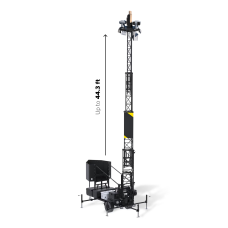
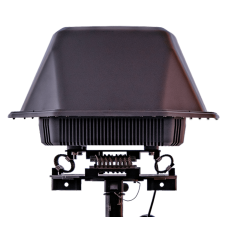
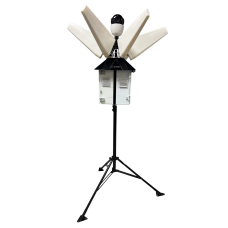
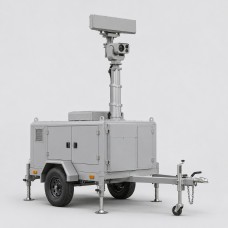


Multi-sensor systems combine multiple independent detection modalities—such as passive RF, Remote ID, radar, and EO/IR thermal imaging—into a single integrated platform managed by unified C2 software. They represent the gold standard for airports, ports, utilities, and major events.
How the technology works and what it detects
The core advantage of multi-sensor fusion is cross-validation: each modality compensates for another's physical blind spots while drastically cutting false alarms. Passive RF delivers early protocol classification, radar or panoramic IR catches non-emitting autonomous aircraft, and PTZ EO/IR confirms the target visually. Unified C2 software correlates all inputs into a single de-duplicated airspace track.
Key selection criteria for civil sites
- Fixed vs rapid-deploy tower: choose permanent multi-sensor perimeters (DroneSentry, NiDAR CUAS) or self-contained mobile trailers (DedroneTrailer+, Cerberus XL) for events and temporary sites.
- Sensor mix & licensing: check whether active radar requires local spectrum approval or whether a fully passive RF + Remote ID + EO/IR stack is preferred.
- Track fusion quality: ensure the C2 engine correlates overlapping detections into a single unified alert rather than duplicate tracks.
- Power autonomy & logistics: evaluate generator/solar/battery autonomy for mobile trailers and ongoing maintenance intervals.
Comparison of representative models in this category
| Model | Manufacturer | Deployment | Primary strength |
|---|---|---|---|
| DedroneTrailer+ | Dedrone | Mobile trailer | Autonomous RF + PTZ tower |
| DroneSentry | DroneShield | Fixed multi-sensor | RF + radar + EO/IR + C2 |
| Cerberus XL | Teledyne FLIR | Mobile tower | Long-range radar + thermal |
| NiDAR CUAS | MARSS | Integrated perimeter | AI air & surface fusion |
Site planning, integration & procurement checklist (RFQ)
- Site geometry and line-of-sight review: before finalizing models, prepare a perimeter layout with roof or mast elevations, priority approach sectors, and local sources of RF or acoustic interference.
- Power, network, and cybersecurity readiness: confirm PoE or AC/DC power availability, backhaul links, and whether your IT policy requires air-gapped on-premises servers or permits cloud dashboards.
- Alerting and escalation workflows: define who monitors 24/7 alerts, whether automated camera cueing (slew-to-cue) is needed, and what export formats are required for incident reporting.
- Formal quotation and manufacturer documentation: we prepare tailored RFQs with recommended system configurations, lead-time estimates, and delivery options across the UK, EU, and worldwide.
Frequently asked questions (FAQ)
When is a multi-sensor system justified over a single RF sensor?
Whenever false-alarm tolerance is low and consequences are high—such as airports, seaports, energy plants, and major venues—or when autonomous radio-silent drones must be covered.
Can we start with one sensor and expand to multi-sensor later?
Yes. Modular platforms allow you to deploy passive RF and C2 first, then add EO/IR cameras, acoustic arrays, or Remote ID receivers as requirements grow.
How quickly can mobile multi-sensor towers be deployed?
Trailer-mounted systems like DedroneTrailer+ and Cerberus XL can be positioned and operational within minutes without permanent civil works.
How do I request pricing, lead times, and sizing support for my site?
Submit an RFQ with your site perimeter details, target quantity, and integration requirements. We will prepare a formal quote with delivery options to the UK, EU, or worldwide; final technical specifications are governed by the official manufacturer datasheet and order confirmation.
Related technologies
To build resilient, layered civil airspace awareness, teams typically combine this category with complementary sensing and software layers:
All products supplied by Drone Detectors (AEROTRACE TECHNOLOGIES LTD, United Kingdom) are detection-only civil monitoring solutions without jamming or active mitigation. Formal quotes (RFQ) and configurations are prepared on request with delivery to the UK, EU, and worldwide.