
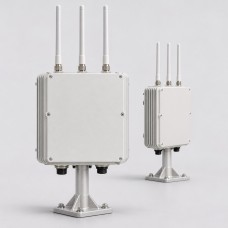
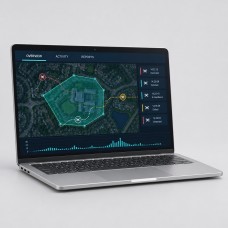
Drones are used to fly contraband over prison walls, often at night and in a few minutes. A correctional facility needs to see a drone as it approaches, know where it is going to drop, and know where the pilot is standing outside the perimeter. This page collects the models in our catalogue whose manufacturers name prisons or correctional facilities among their target sites, plus fixed perimeter sensors suited to compact secure sites. All equipment is passive and detection-only.
What a prison drone detection system has to do
- Detect early enough to act: a drop takes minutes, so the alert must come while the drone is still approaching the wall, not when it is over the yard.
- Locate the pilot outside the perimeter. RF direction finding and Remote ID give the controller's position, which is what staff and police need to intervene.
- Work around the clock in an urban RF environment with few false alarms from Wi-Fi, mobile networks and staff radios.
- Cover the whole perimeter with fixed, tamper-resistant sensors on walls or masts, networked into one picture.
- Keep evidence: time-stamped tracks, flight paths and pilot locations that can be handed to the police and prosecutors.
Models for prisons and correctional facilities
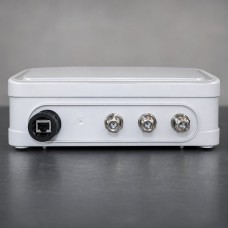
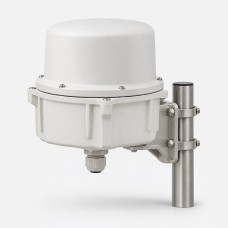
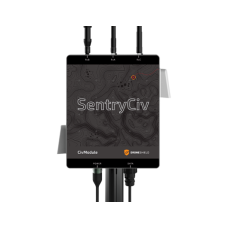
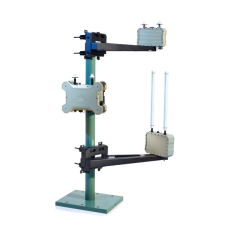
AirWarden Spectrum, Sentrycs Fixed Kit and WhiteFox STRATUS are designated for correctional facilities by their manufacturers; Dedrone RF-360, DroneShield SentryCiv and DroneScout ds230 are fixed sensors for compact perimeter sites that complete the picture.
| Layer | Model | Manufacturer |
|---|---|---|
| RF detection & direction finding | RF-360 | Dedrone |
| SentryCiv | DroneShield | |
| Fixed Kit | Sentrycs | |
| AirWarden Spectrum | AeroDefense | |
| Remote ID receivers | DroneScout ds230 | BlueMark Innovations |
| C2 & incident software | STRATUS | WhiteFox |
Most of these products are priced on request because the configuration depends on the site. The product cards below show availability and published prices where they exist.
Limitations to plan for
- Passive RF only sees drones that transmit a control, telemetry or video link. Fully autonomous, radio-silent flights are invisible to it, and buildings and other obstacles shorten the real range compared with the declared figure.
- Remote ID only sees drones that broadcast it. In the EU direct remote identification is required for class C1, C2, C3, C5 and C6 drones; older, modified or home-built drones may not broadcast anything.
- EO/IR cameras and acoustic sensors need line of sight or low background noise. They confirm and classify best when cued by a wide-area RF or Remote ID layer.
- Declared ranges are manufacturer figures for ideal conditions. Mounting height, terrain and RF noise decide the real coverage, so a site survey comes before the final layout.
- Detection-only. We do not supply jamming or other mitigation. Any response to a drone is a matter for the competent authorities under national law.
Documentation and further reading
- Commission Delegated Regulation (EU) 2019/945 — product rules for drones sold in the EU, including the direct remote identification that Remote ID receivers read.
Our guides on planning and sensor choice:
- Detection-Only vs Active Counter-UAS: EU & UK Legal Framework for Civil Sites
- From detection to a useful incident record
- Single-Sensor vs Multi-Sensor Fusion: Designing Layered Airspace Security
- Remote ID vs Passive RF Sensors: What Compliant Receivers Miss
Drone detection for other types of site
How to request a quote
Send us the length and height of the perimeter, the surroundings (urban, rural), where sensors can be mounted and powered, and whether you already have a security control room. We will propose a sensor combination from the models above and a formal quote with lead times and delivery to the UK, EU or worldwide.